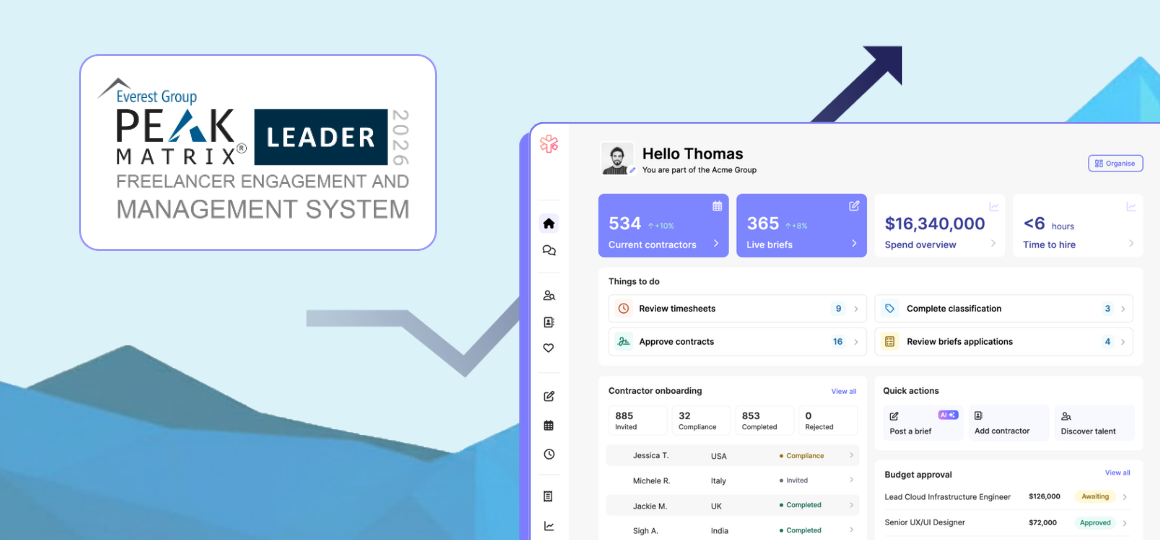

More organizations are relying on contractors, independent specialists, freelancers, and external talent to close skill gaps, accelerate projects, and scale their workforce without increasing permanent headcount.
What used to be occasional freelance hiring is now embedded in workforce strategy.
As contingent workforce engagement grows, so does operational complexity. Independent contractors may be engaged across departments, business units, and countries. Worker classification rules differ by jurisdiction. Contracts vary by engagement. Payments must move across currencies. Finance teams need spend visibility, while legal teams require documentation that can withstand regulatory scrutiny.
This is where a freelancer management system (FMS) becomes essential.
A freelancer management system (FMS) is software that helps organizations manage freelancers, independent contractors, consultants, and other external talent through a centralized platform covering sourcing, onboarding, classification, contracts, payments, and reporting.
Instead of relying on spreadsheets, email threads, shared drives, and disconnected financial tools, organizations can manage their contingent workforce through one structured system.
As contractor engagement expands, this structure becomes critical for maintaining visibility, governance, and compliance.
What is a freelancer management system?
A freelancer management system is a software platform designed to help organizations manage non-employee talent in a structured and compliant way.
Despite the name, these systems rarely focus solely on freelancers. Most organizations use them to manage a broader contingent workforce that includes:
- Independent contractors
- Freelancers
- Consultants
- Project-based specialists
- External talent
- Agency-sourced workers
An FMS becomes the system of record for contractor engagements. It standardizes onboarding, strengthens worker classification governance, centralizes contracts, simplifies payments, and provides visibility into external workforce activity.
For organizations hiring contractors across multiple regions, this centralization becomes especially important. Worker classification laws, tax obligations, and compliance requirements vary significantly between jurisdictions. Managing these relationships without structured processes can introduce operational and legal risks.
Why invest in a freelancer management system?
There are several practical reasons organizations implement a freelancer management system.
An effective FMS helps organizations:
- Streamline sourcing and onboarding of external talent
- Reduce worker misclassification risk
- Simplify contractor payments across countries
- Improve visibility into contingent workforce spend
- Standardize contract governance
- Reduce manual administrative work
- Improve the overall contractor experience
Many companies initially manage freelancers and contractors informally. A hiring manager identifies a specialist, onboarding happens through email, and invoices are processed manually.
This approach can work when a company engages only a small number of freelancers.
However, as contractor engagement expands across teams or regions, challenges begin to emerge. Organizations often encounter:
- Multiple departments hiring contractors independently
- Limited visibility into total contractor spend
- Inconsistent worker classification processes
- Contracts scattered across email or shared drives
- Payment processes fragmented across tools
A freelancer management system helps standardize these workflows across the organization, creating consistency and improving oversight.
The 7 key features of a freelancer management system
When evaluating a freelancer management system, organizations should focus on seven core capabilities that support the full lifecycle of managing freelancers, independent contractors, and external talent.
These include:
- Talent sourcing and internal talent pools
- Onboarding and compliance management
- Engagement and contract lifecycle management
- Global payments and invoicing
- Spend visibility and workforce analytics
- Integration with existing business systems
- User experience and platform adoption
The sections below explore each feature in more detail and explain why they matter when managing a modern contingent workforce.
1. Talent sourcing and internal talent pools
Sourcing is often the first capability organizations evaluate when selecting an FMS.
However, effective sourcing is not only about posting roles externally. A strong freelancer management system should allow organizations to build and maintain an internal network of trusted external talent.
Look for systems that support:
- Searchable contractor and freelancer databases
- Engagement history tracking
- Internal ratings or feedback on previous work
- Private talent pools by skill or department
- Integration with external marketplaces or sourcing platforms
Over time, this internal talent network becomes a strategic advantage.
Rather than starting from scratch for every project, hiring managers can quickly re-engage freelancers or independent contractors who already understand the company’s workflows and expectations.
This reduces time-to-hire and often improves project delivery.
2. Onboarding and compliance management
Onboarding is where many contingent workforce risks originate.
A capable freelancer management system should standardize onboarding processes across departments and regions.
Core onboarding capabilities typically include:
- Identity verification
- Right-to-work documentation
- Tax form collection (including 1099 documentation in the United States)
- Worker classification assessments
- Digital contract generation and e-signatures
- Secure storage of compliance documentation
Worker classification is particularly important.
Regulations differ widely between jurisdictions. In the United States, independent contractor status must align with IRS guidance. In the United Kingdom, IR35 governs off-payroll working rules. Across the European Union, employment classification frameworks vary by country.
An FMS helps organizations document classification decisions and maintain audit-ready records.
Consistency across onboarding processes significantly reduces the risk of missing documentation or misclassification exposure.
3. Engagement and contract lifecycle management
Managing freelancers and contractors does not stop once onboarding is complete.
A freelancer management system should provide visibility across the entire engagement lifecycle.
Important lifecycle features include:
- Engagement creation and assignment
- Contract duration tracking
- Renewal and extension workflows
- Amendment tracking
- Centralized contract storage
Without structured lifecycle management, contractor engagements may be extended informally or evolve beyond their original scope.
This can introduce compliance risks and unexpected budget increases.
A centralized system ensures contracts, timelines, and terms remain visible and controlled across the organization.
4. Global payments and invoicing
Paying a global freelance and contractor workforce can quickly become complex.
A strong freelancer management system should simplify payment management by supporting:
- Multi-currency payments
- Consolidated invoicing
- Automated invoice approvals
- Tax documentation management
- Payment tracking and reporting
Payment workflows vary significantly depending on where contractors are located. Currency conversion, tax obligations, and local payment regulations can introduce administrative complexity.
Centralizing payments through a single platform reduces operational burden while ensuring contractors are paid accurately and on time.
Reliable payment processes also help organizations maintain strong relationships with high-performing external talent.
5. Spend visibility and workforce analytics
As contingent workforce engagement grows, leadership teams need better insight into how external talent is being used.
A freelancer management system should provide reporting across areas such as:
- Contractor spend by department
- Regional workforce distribution
- Engagement duration and renewals
- Supplier utilization
- Compliance metrics
Many organizations underestimate how quickly contractor spend can increase when hiring decisions are decentralized.
Centralized reporting helps finance and leadership teams understand where contractors are delivering value and where spending may need to be reviewed.
6. Integration with existing business systems
A freelancer management system should integrate with the organization’s broader technology ecosystem.
Look for platforms that connect with:
- HR information systems
- Applicant tracking systems
- ERP and finance platforms
- Procurement tools
- Accounting software
- Single sign-on providers
Integration ensures contractor data flows across systems and remains consistent.
Without integration, teams often need to manually transfer information between platforms, increasing administrative work and the risk of errors.
7. User experience and platform adoption
Technology only delivers value when people use it.
A successful freelancer management system must balance governance with usability.
Look for systems that offer:
- Clear, role-based dashboards
- Intuitive workflows for hiring managers
- Self-service portals for freelancers and contractors
- Mobile-friendly interfaces
- Accessible support and training resources
Hiring managers typically prioritize speed and flexibility when engaging external talent. Finance teams require clarity around payments and invoicing. Legal teams need structured documentation.
A platform that supports all these stakeholders is more likely to achieve broad adoption across the organization.
Choosing the right freelancer management system
Selecting an FMS should align with the organization’s broader contingent workforce strategy.
When evaluating platforms, consider:
- How contractor engagement is currently managed
- Which jurisdictions your organization operates in
- How payments are processed today
- Whether worker classification decisions are documented consistently
- How much visibility leadership has into contractor spend
Request demonstrations that show the full contractor lifecycle, from sourcing to payment.
Understanding how the platform handles onboarding, classification, contract management, and reporting will help determine whether it supports your organization’s long-term workforce strategy.
Frequently asked questions
Is a freelancer management system the same as contingent workforce management software?
In many cases, yes. Both terms refer to platforms designed to manage non-employee workers such as freelancers, independent contractors, and consultants.
Does a freelancer management system replace payroll?
No. Independent contractors are typically paid through invoice-based processes rather than payroll systems. An FMS supports contractor payments and documentation alongside payroll infrastructure.
Can a freelancer management system support international contractors?
Many freelancer management systems support global contractor engagement, including multi-country compliance workflows and multi-currency payments.
Conclusion
Freelancers, independent contractors, and external specialists now play a central role in how many organizations operate.
Managing that external workforce through manual processes or disconnected systems introduces operational inefficiencies and compliance risks.
A well-designed freelancer management system provides the infrastructure needed to manage sourcing, onboarding, classification, contracts, payments, and reporting within one centralized platform.
By focusing on the seven features outlined above, organizations can select a system that supports scalable, compliant contingent workforce management.
YunoJuno provides a global freelancer management system that helps businesses source, onboard, manage, and pay independent contractors and freelancers across 165+ countries through a single platform.