


US Employer Tax Calculator
Hiring a new employee involves more than just their salary. In addition to wages, employers are responsible for various payroll associated taxes. These taxes can add up and need to be planned for when scaling your team. Our US Employer Tax Calculator is designed to give you a clear picture of these additional costs of employment, so you can budget confidently and avoid surprises.
Using the US Employer Tax Calculator
Get an estimate of employment taxes in a few simple steps:
- Input the employee’s pay: Enter the annual salary for the worker.
- Select the state: Payroll taxes vary by state. By choosing the state where the employee works, the calculator can include the correct state tax parameters.
- See the results: The calculator will display a breakdown of employer taxes (federal and state taxes) for that salary.
Using our calculator takes the guesswork out of budgeting for a new hire. Instead of manually crunching numbers for each tax and referencing IRS tables, you get an instant estimate. This is especially useful for contingent workforce managers or procurement teams who need to compare costs quickly. Armed with these estimates, you can focus on building your team without financial surprises.
* Note: This tax calculator is for informational purposes only and may exclude local/state specific taxes. Payroll tax obligations can vary based on your business’s location, size, and structure. When in doubt, consult a tax professional or accountant. Failing to pay the right taxes can lead to penalties, so it pays to get it right the first time.
Understanding US employer payroll taxes
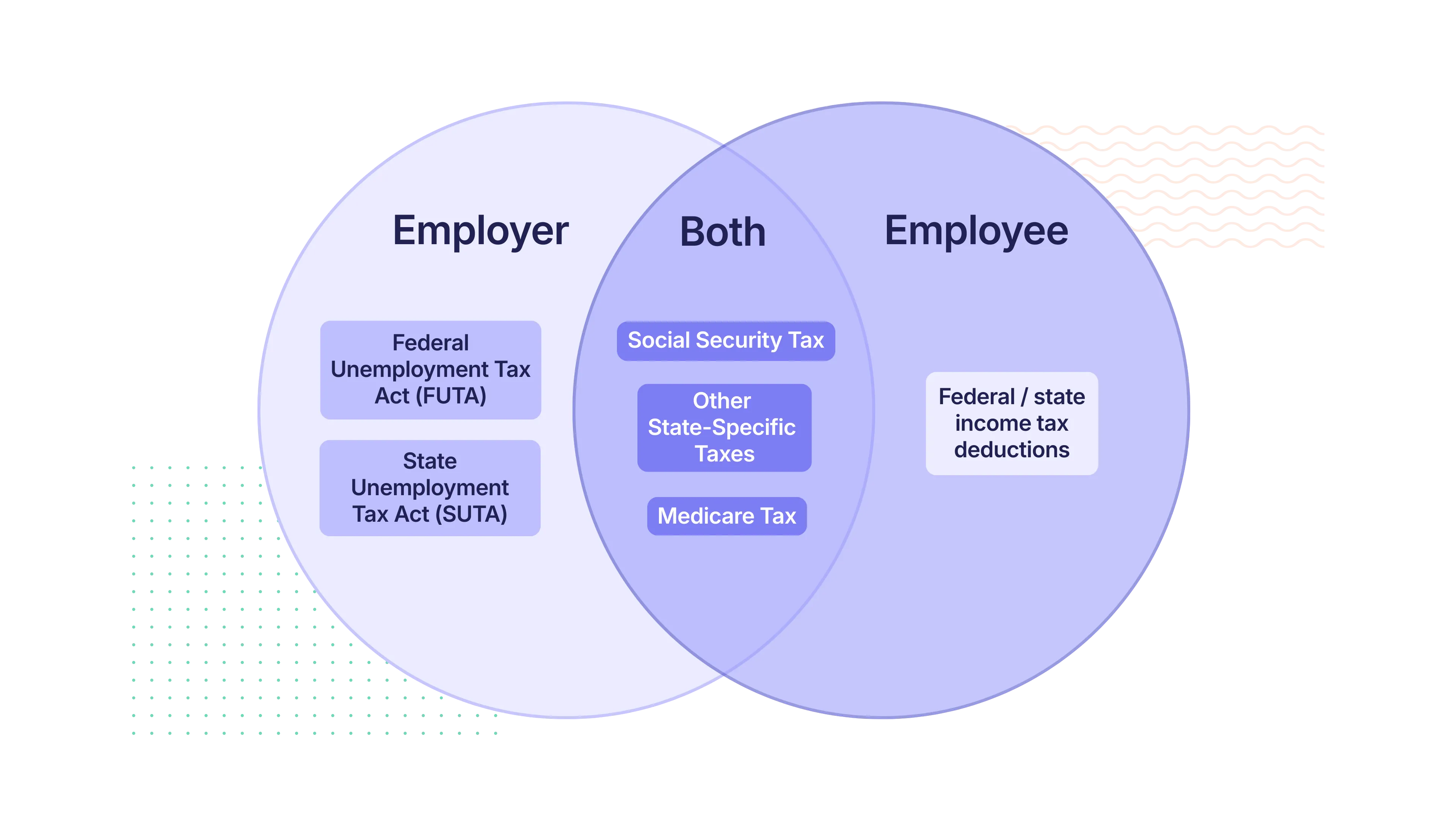
Bringing on an employee means taking on certain tax obligations. Payroll taxes in the U.S. are generally split by who pays them:

These are taxes that come directly out of the employer’s pocket and are over and above the employees base salary. These taxes include:
- Federal Unemployment Tax Act (FUTA): FUTA taxes fund state unemployment benefits for workers who have lost their jobs through no fault of their own. FUTA is 6.0% on the first $7,000 of each employee’s annual wages. Employers who pay their state unemployment tax bill on time receive a federal credit of up to 5.4%, resulting in a net 0.6% FUTA rate.
- State Unemployment Tax Act (SUTA): Otherwise known as State Unemployment Insurance (SUI). This is a state-level payroll tax that employers must pay (except in Alaska, New Jersey and Pennsylvania) to fund unemployment benefits for workers who lose their jobs. The tax rate and wage base depends on the specific state and the employer’s experience (e.g., a history of unemployment claims can raise your rate). New employers often start at a standard entry rate until their experience level has been adjusted by the state department.
The Federal Insurance Contributions Act (FICA) is a federal law that mandates payroll taxes for Social Security and Medicare. FICA taxes are split between the employer and the employee:
- Social Security Tax: Social Security is a federal program that provides retirement, disability, and survivor benefits to eligible individuals. This tax is 6.2% of taxable wages for the employer, and another 6.2% is withheld from the employee’s paycheck. The tax applies only up to a yearly income cap known as the Social Security wage base. For example, in 2025 the wage base was $176,200 and it increased to $184,500 for 2026. Earnings above that cap are not taxed for Social Security in that year.
- Medicare Tax: Medicare taxes fund health services for the elderly, the disabled and people with other qualifying health conditions. This tax is 1.45% of all wages for the employer, and another 1.45% withheld from the employee. Unlike Social Security, Medicare tax has no annual wage limit, every dollar of wages is taxed. For most employees, the total Medicare contribution is 2.9% of wages (split evenly between employer and employee). There is an Additional Medicare Tax of 0.9% that applies only to employees on wages above $200,000 per year (threshold for single filers; $250,000 for married filing jointly). Employers do not need to match that amount.
- Other State-Specific Taxes: Depending on the state, there may be additional payroll taxes that are funded either by the employer or the employee. For example, some states have employer-funded disability insurance or paid family leave programs (e.g., California and New York), while other states finance these programs via small employee payroll deductions. It’s important to check your state’s rules so you know if you, the employer, are on the hook for these taxes.
These include federal and state income taxes that you withhold from employees’ paychecks on their behalf. Employers don’t actually fund these out of pocket – the employee funds them – but employers are responsible for calculating the correct withholding and depositing it with the government.
The amount varies based on each employee’s earnings, W-4 withholding allowances, and the tax rates in your state. As an employer, your role is to handle these withholdings and payments to keep your company compliant and your employees on track with their taxes.
Manage your global contractor workforce with confidence
From sourcing to payments, manage your contingent workforce with automation, compliance, and real-time visibility built in.
Are you a freelancer? Join YunoJuno


