
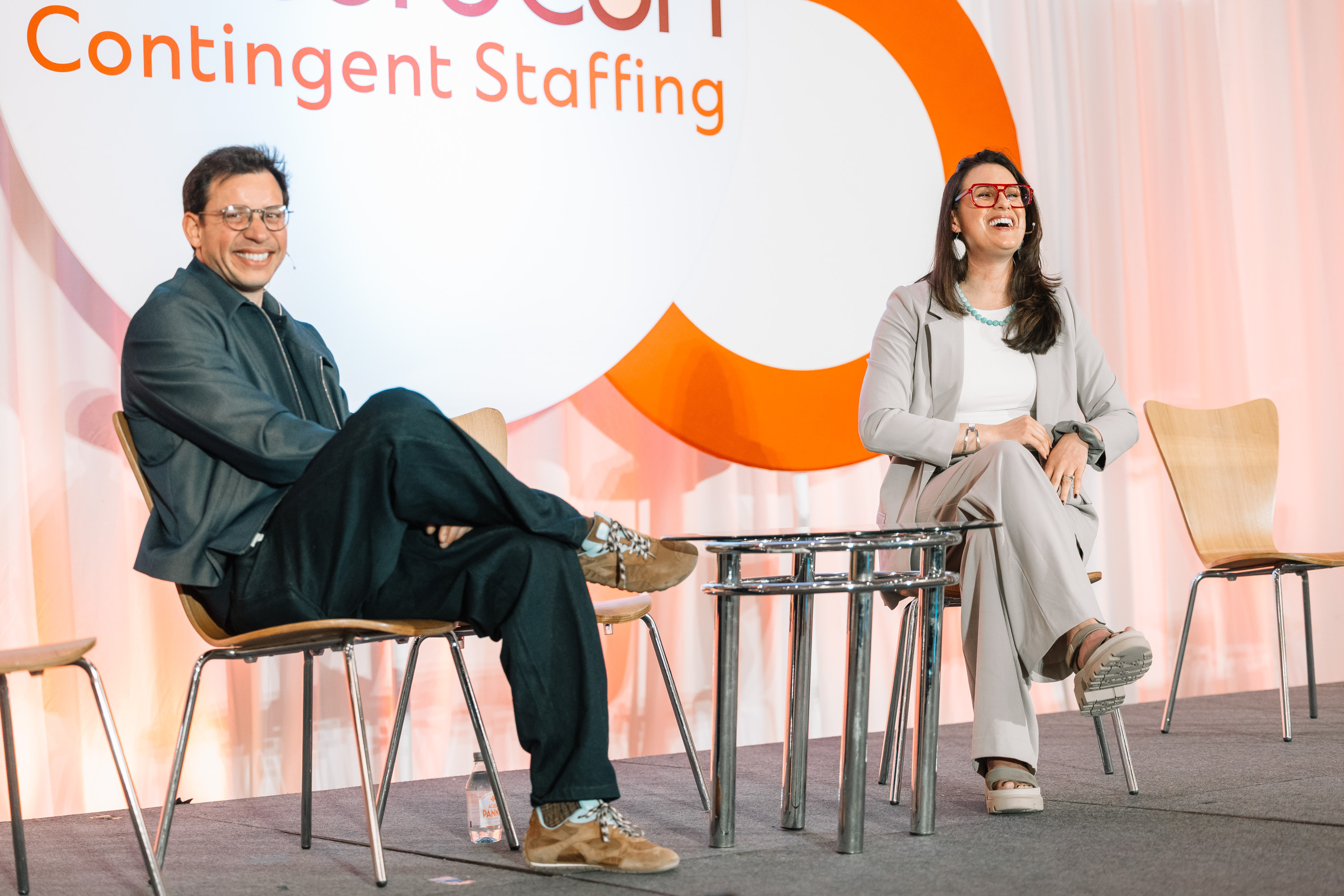
At ProcureCon US Contingent Staffing 2026 in Las Vegas, YunoJuno took to the main stage to explore one of the most pressing questions in workforce management today: how are contingent workforce programmes evolving - and what does it take to stay ahead?
The keynote session, titled "The Great Recalibration: How Contingent Workforce Programs Are Evolving," brought together YunoJuno COO Joao Martires and Annie Austin Rowe, Vendor Strategy & Operations at Google DeepMind, for a conversation that cut through the noise and got to the heart of where contingent workforce strategy is headed.
The session drew on real-world experience managing large-scale contractor programmes, new procurement data insights, and how AI adoption is shaping the Future for procurement & contingent workforce leaders.
Here's a full breakdown of what was discussed.
What is "The Great Recalibration"?
The session opened with a big question: the rules that governed workforce strategy even three or four years ago no longer apply. We are in a period of fundamental recalibration where organizations are shifting how they access, deploy, and manage external talent.
Five forces are driving this change simultaneously:
- Demand for flexible, specialist skills
- AI and automation reshaping delivery
- Economic pressures demanding leaner models
- The evolution of Freelancer Management Systems (FMS)
- A generational shift in workforce expectations
Joao Martires and Annie Austin Rowe, Vendor Strategy & Operations at Google DeepMind were in agreement that none of these forces is operating in isolation. Together, these forces are reducing timelines, raising expectations, and forcing organisations to move beyond legacy approaches for contingent workforce management.
The demand for agile workforces
The first and most foundational shift is the growing demand for flexible, skills-based access to talent. Organisations are stepping away from rigid headcount models and moving towards a more fluid approach - engaging specialist expertise when and where it is needed, rather than attempting to maintain all capabilities in-house permanently.
This is a competitiveness strategy. The ability to rapidly access niche expertise - whether that's an AI/ML engineer for a six-month build, a compliance specialist for a regulatory project, or a creative director for an OOH campaign - is becoming a meaningful differentiator between organisations that can move quickly and those that can't.
For procurement and workforce leaders, the implication is clear: the question is no longer whether to build a contingent workforce programme, but how scalable that programme can become.
AI and automation - with human accountability
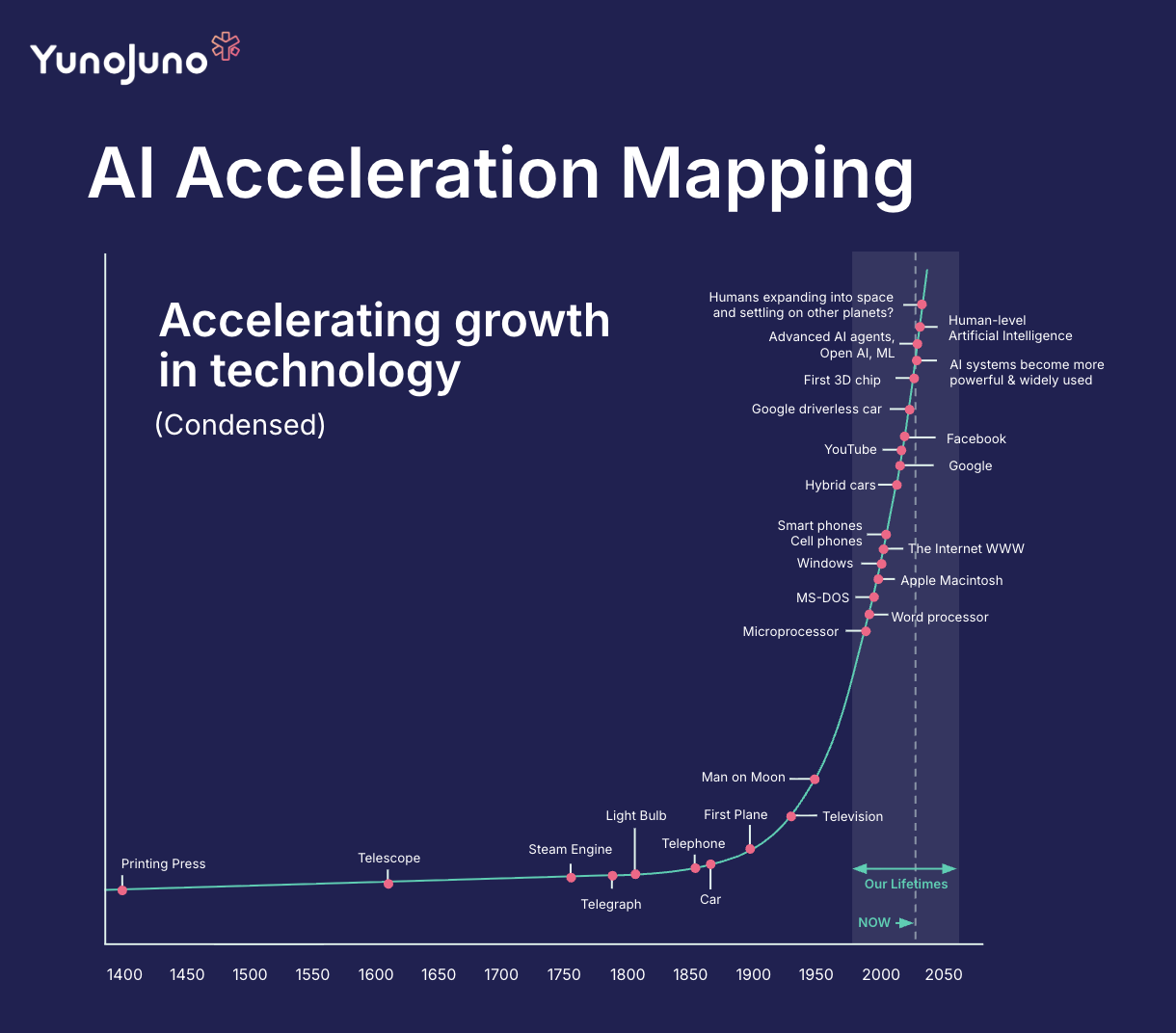
The session included a compelling AI Acceleration map charting humanity's technological progress - and the curve of innovation has become nearly vertical. We are not preparing for an AI-driven future. We are living in it.
As Google CEO Sundar Pichai has publicly commented, “AI is the most profound technology humanity is working on. More profound than fire or electricity or anything that we’ve done in the past.”For contingent workforce leaders, this is not an abstract philosophical point. It has direct operational implications.
AI is transforming how work is sourced, scoped, delivered, and evaluated. According to Gartner, 50% of procurement contract management will be AI-enabled by 2027, and 80% of enterprises will have used GenAI APIs or models by 2026.
YunoJuno's own AI Talent Agent is a direct response to this reality. The tool draws on comprehensive skills data across YunoJuno's contractor vetted network to compare profiles, benchmark capabilities, and surface the most relevant talent for each engagement - making every hiring decision faster and more informed.
Building on the topic, Annie Austin Rowe raised a highly relevant point here that speed and automation must not come at the expense of human accountability. As AI becomes more embedded in contracting workflows - from generating statements of work to flagging compliance issues - enterprises need to be deliberate about where human oversight sits, building in structured human review at key decision points.
Economic pressures and the leaner workforce
Macroeconomic uncertainty is reshaping how organisations think about workforce composition. According to the World Economic Forum's Future of Jobs Report 2025, 77% of employers plan to upskill their workers for AI - but 41% also plan workforce reductions as a result of automation. Half of all employers are actively reorienting their business models to leverage AI opportunities.
This creates a tension that procurement and workforce leaders must navigate carefully: the need to reduce fixed costs and headcount risk while simultaneously accessing the specialist skills required to execute AI-driven transformation.
The answer for many organisations is a more strategic approach to contingent workforce management - no longer using contractors as a flexible buffer, but as a core part of their workforce strategy.
The maturation of Freelancer Management Systems (FMS)
One of the most significant structural shifts of the past three years has been the rapid maturation of Freelancer Management Systems. What was once a category of basic contractor tracking tools has become a sophisticated layer of workforce infrastructure - enabling global onboarding, multi-jurisdiction compliance, automated payments, skills benchmarking, and real-time reporting at scale.
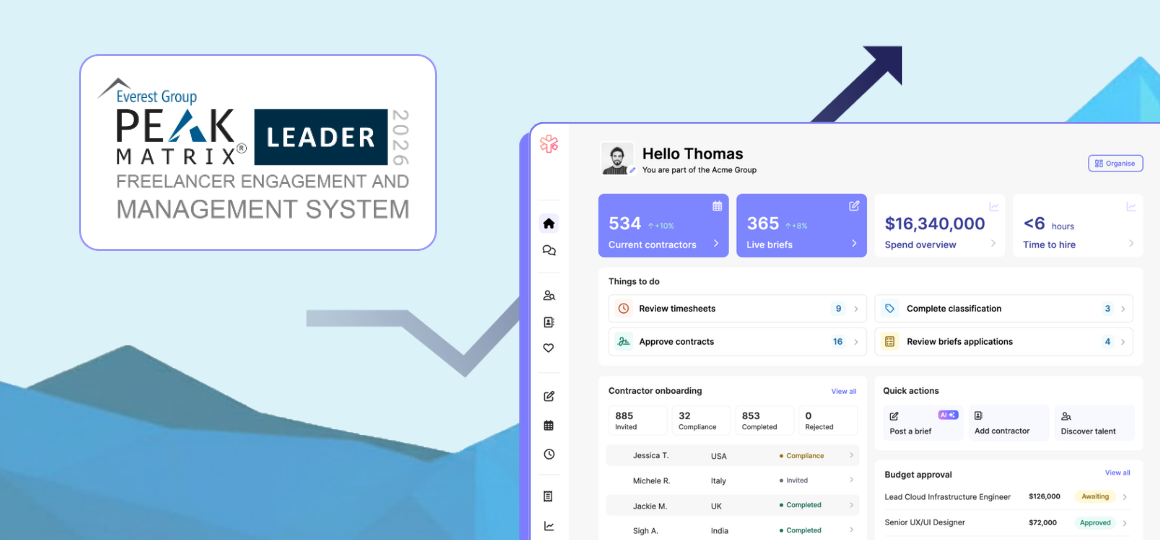
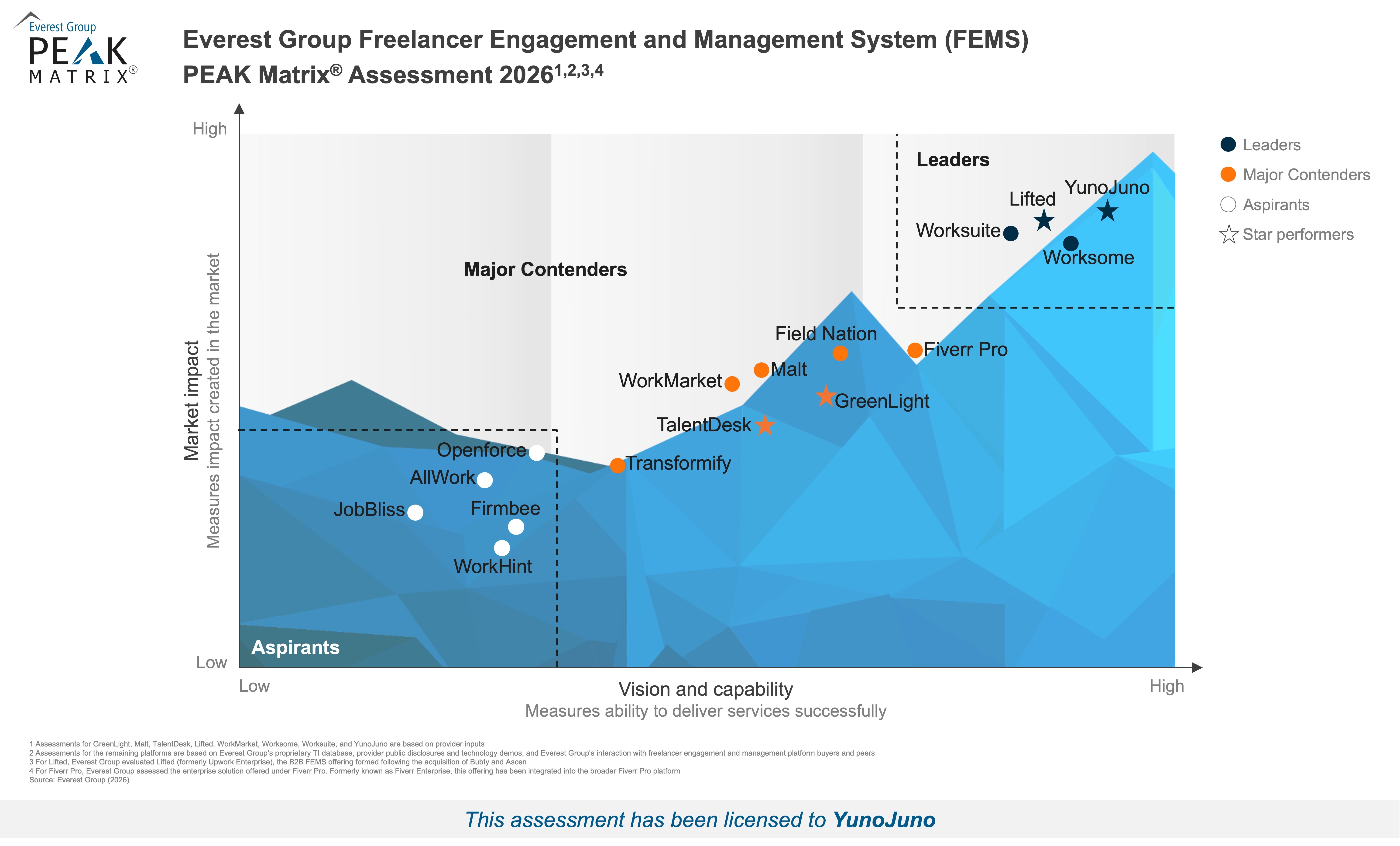
YunoJuno's recognition as highest Leader in the Everest Group FEMS PEAK Matrix® 2026 reflects this maturation. The assessment evaluates vendors across two dimensions: market impact and vision and capability — covering areas including extended technology capability, ease of UI/UX, and AI and automation.
The session highlighted several areas where FMS maturity is unlocking new capability:
- Automated global compliance workflows guiding contractors through the correct onboarding steps based on their country of residence and worker classification (e.g., 1099 to W-9 form, Sole Trader to Unique Tax Reference)
- Direct sourcing from pre-approved talent pools, reducing time-to-hire and agency dependency
- Global payments infrastructure that ensures contractors are paid accurately and on time, regardless of geography
- Workforce analytics that give procurement leaders real visibility into spend, headcount, and skills distribution
Rising expectations from the workers themselves
The final force is the shift in what workers themselves expect from the organisations they work with.
Highly skilled independent professionals are, by definition, operating in a market with options - something that is becoming ever more enticing for those working in permanent roles. Contractors choose who they work with based not just on the work itself, but on the quality of the experience: how they are onboarded, how they are paid, how they are communicated with, and whether the organisation treats them as a genuine strategic partner or as an operational afterthought.
Organisations that get this right build preferred-worker relationships - contractors who return for subsequent engagements, refer their networks, and produce better work because they feel invested in the outcome. Organisations that get it wrong find themselves unable to access the best talent in a competitive market.
This is why YunoJuno places significant emphasis on the contractor experience as a core product dimension - with a 5 star Google Review score reflecting strong satisfaction from both the client and contractor sides of the platform.
Closing Thoughts
The theme of "The Great Recalibration" clearly resonated with the leaders in the room. The forces reshaping contingent workforce management - skills demand, AI, economic pressure, worker expectations, FMS maturity - are all gathering pace. The organisations that recognise this and act on it now will emerge from this period of change with programmes that are faster, leaner, more compliant, and best placed for competitive advantage.
How YunoJuno's Leading FMS can help
YunoJuno helps organizations gain full visibility, ensure compliance, and seamlessly manage contractor and flexible talent globally.
If you are looking to build a more agile and scalable workforce strategy, book a call with our team to learn more.