As organizations accelerate AI adoption, invest in digital transformation, and rethink how they access specialist talent, demand for contractors remains strong across technology, product, and business functions.
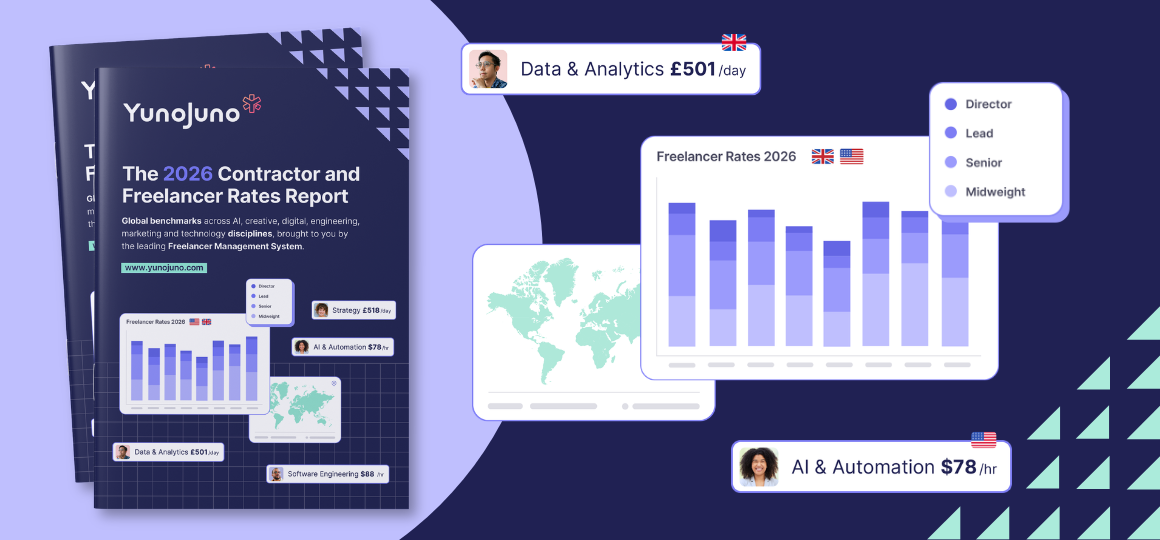
YunoJuno's 2026 Contractor and Freelancer Rates Report, based on more than 182,000 workforce data points collected across 2024 and 2025, reveals how contractor rates are evolving, which skills command the highest premiums, and how AI is reshaping the future of work.
The findings highlight a market increasingly driven by specialist expertise, flexible talent strategies, and outcome-focused delivery.
The highest contractor rates in 2026 are concentrated in cloud infrastructure, software engineering, product management, and strategy. The data also shows that AI skills continue to command premium rates in certain disciplines, while direct sourcing now accounts for more than 80% of contractor bookings.
Technology skills remain the highest-paid contractor disciplines
Technology continues to dominate the contractor market, with specialist technical skills attracting some of the highest rates across both the UK and US.
Cloud & Infrastructure professionals command the highest average rates of any discipline analyzed, reaching:
- $93 per hour in the US
- £566 per day in the UK
Software Engineering and Product Management also remain among the highest-paid contractor disciplines, reflecting continued demand for specialists capable of building, scaling, and optimizing digital products and services.
Across all disciplines, average contractor rates reached $68 per hour in the US and £410 per day in the UK.
The data suggests that while organizations continue to invest heavily in technology and transformation initiatives, they are increasingly willing to pay a premium for highly specialized expertise that can deliver measurable business outcomes quickly.
This trend is particularly evident in disciplines where businesses are balancing innovation with execution. Organizations are not simply looking for additional capacity. They are looking for contractors who can accelerate projects, solve complex challenges, and contribute from day one.
AI is becoming a capability, not a standalone role
Much of the conversation surrounding AI has focused on the emergence of entirely new job categories. The data suggests a more nuanced reality.
Rather than creating a separate discipline, AI is increasingly becoming an embedded capability across existing roles and functions.
Data & Analytics showed the highest concentration of AI-related skills, with more than 26% of contractor skills linked to AI capabilities. Significant adoption is also visible across Software Engineering, Product Management, Operations, and Project Management disciplines.
This shift reflects how organizations are using AI in practice. Rather than hiring AI specialists in isolation, businesses are looking for professionals who combine deep domain expertise with AI-enabled ways of working.
As Runar Reistrup, CEO of YunoJuno, explains:
"While much of the conversation around AI has focused on disruption, the reality is more nuanced. AI is not creating an entirely separate category for specialty, but instead an embedded layer, reshaping how work is being delivered. The contractors creating the most value are those combining deep domain expertise with AI-enabled execution."
For contractors, this means AI proficiency is increasingly becoming an expectation rather than a differentiator. The strongest opportunities are emerging for professionals who can combine specialist knowledge with practical AI application.
AI skills are driving premium rates in specific disciplines
Although AI adoption is becoming widespread, the report found that AI skills do not yet create a significant rate premium across the market as a whole.
However, the impact varies considerably by discipline.
Software Engineering showed the strongest AI-related uplift, with contractors possessing AI skills earning rates approximately 26% higher than their peers.
Project Management followed closely, with AI-enabled professionals commanding rates around 17% higher than average.
This reflects the areas where AI is delivering the most immediate commercial value. In software engineering, AI is accelerating development workflows, improving productivity, and enabling faster delivery cycles. Within project management, AI is helping streamline planning, reporting, resource allocation, and operational efficiency.
The findings suggest organizations are rewarding professionals who can demonstrate tangible business outcomes through AI adoption, rather than simply possessing AI-related knowledge.
As AI adoption matures, the premium is likely to become less about knowing how to use AI tools and more about applying them effectively within a specific discipline. Organizations are increasingly prioritizing outcomes over experimentation.
Direct sourcing has become the dominant hiring strategy
One of the most significant workforce trends identified in the report is the continued growth of direct sourcing.
More than 80% of contractor bookings were made through organizations' existing contractor networks, highlighting a major shift in how businesses access talent.
Rather than relying solely on recruitment agencies or external marketplaces, organizations are increasingly building and managing their own pools of trusted contractors and independent professionals.
This trend reflects the growing importance of Freelancer Management Systems (FMS) in helping businesses:
- Build talent communities
- Re-engage proven contractors
- Improve workforce visibility
- Reduce sourcing costs
- Accelerate hiring timelines
- Maintain compliance across global markets
For many organizations, contractor hiring is no longer a one-off transaction. It is becoming a strategic capability. Businesses that can identify, engage, and redeploy trusted external talent are gaining a meaningful competitive advantage.
Speed remains a key advantage of contractor hiring
Access to specialist skills remains one of the biggest drivers behind contractor engagement.
While permanent recruitment processes often take three to six months, contractor onboarding can frequently take place within hours.
This speed advantage is particularly valuable for organizations undertaking:
- Digital transformation programs
- AI implementation initiatives
- Cloud migration projects
- Product launches
- Business change programs
- Short-term capability gaps
Organizations facing skills shortages often cannot afford lengthy hiring cycles. Contractors provide access to expertise precisely when it is needed, helping businesses maintain momentum without increasing permanent headcount.
In an environment where priorities can shift quickly, workforce flexibility remains one of the most valuable assets an organization can have.
What these trends mean for workforce planning in 2026
The 2026 data highlights a contractor market that is becoming increasingly sophisticated.
Rather than using contractors purely as a temporary resource, organizations are integrating flexible talent into long-term workforce strategies.
Three themes stand out for workforce leaders.
1. Specialist skills continue to command premium rates
Demand remains strongest for highly specialized expertise across cloud infrastructure, software engineering, product management, data, analytics, and strategy.
Organizations are willing to pay more when skills are difficult to find and directly linked to business outcomes.
2. AI capability is becoming essential
AI is no longer limited to dedicated specialists.
Increasingly, organizations expect AI-enabled delivery across a wide range of disciplines. Contractors who can combine technical or functional expertise with AI capability are well positioned to benefit from this shift.
3. Direct sourcing is becoming a competitive advantage
Businesses that invest in building contractor networks are reducing hiring times, lowering sourcing costs, and gaining access to trusted talent faster than competitors.
As contingent workforce strategies mature, direct sourcing is becoming a core part of workforce planning rather than a supplementary hiring channel.
Why this matters for organizations managing external talent
The findings extend beyond contractor rates.
They provide insight into how organizations are approaching workforce planning more broadly.
The growing adoption of direct sourcing, the continued demand for specialist skills, and the integration of AI into existing roles all point toward a workforce model that is increasingly flexible and skills-led.
For organizations managing contractors, consultants, and other forms of external talent, visibility and workforce intelligence are becoming more important than ever.
Understanding where rates are moving, which skills command a premium, and how competitors are accessing talent can help organizations make better decisions around hiring, budgeting, and workforce strategy.
Download the full 2026 Contractor and Freelancer Rates Report
The complete report provides detailed benchmarks across:
- AI & Automation
- Client Services
- Cloud & Infrastructure
- Creative
- Data & Analytics
- Design
- Marketing & Communications
- Product Management
- Project Management
- Software Engineering
- Strategy
- UX
You'll also gain deeper insight into:
- Global contractor rate benchmarks
- AI adoption trends by discipline
- Workforce planning trends
- Direct sourcing behavior
- Contractor hiring patterns
- The fastest-growing skill areas
Download the full report to explore the latest contractor rates, workforce trends, sourcing insights, and AI adoption data shaping the future of work in 2026.