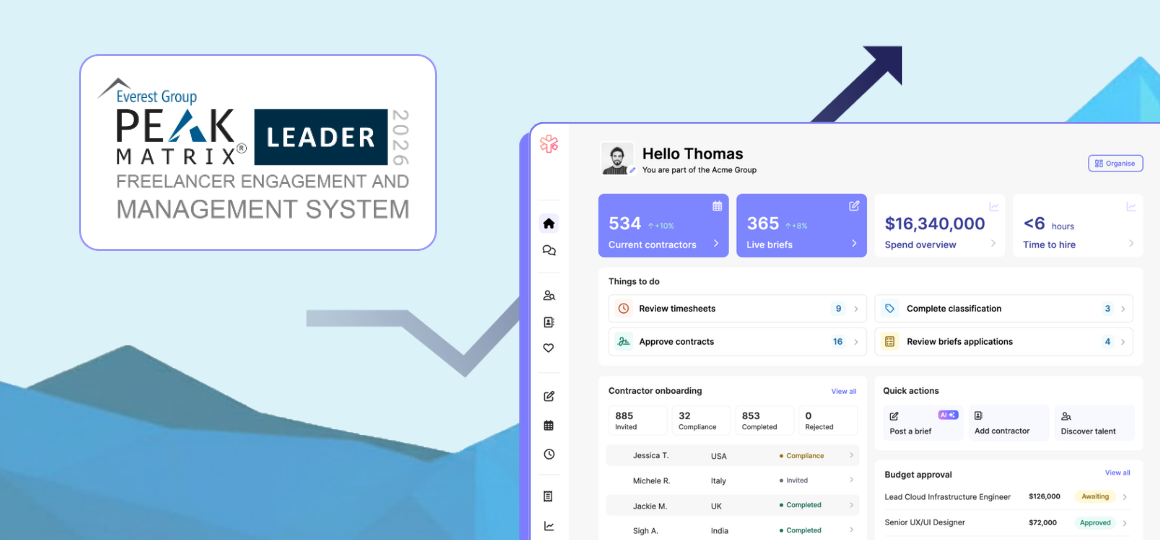
The contingent workforce technology market is crowded, and the terminology buyers encounter, FEMS, VMS, marketplace, direct sourcing platform, often blurs together. Everest Group's Freelancer Engagement and Management System (FEMS) PEAK Matrix® Assessment cuts through that by evaluating 16 leading FEMS platforms against a consistent criteria set, naming YunoJuno as highest Leader and Star Performer in this year's assessment. Broken down, this research offers a clear picture of the capabilities that define a leading platform.
This short guide breaks down what to actually look for, capability by capability.
First, know what you're buying
FEMS are purpose-built to manage the end-to-end freelancer or independent contractor (IC) lifecycle: sourcing, compliance, contracting, and global payments, all in one place. Marketplaces, by contrast, are primarily discovery and sourcing tools that connect enterprises with independent workers through an open talent pool.
Some providers are pure marketplaces. Others layer lightweight management workflows onto a marketplace core. Some are built as vendor-agnostic, end-to-end platforms that support hybrid sourcing, engagement, and compliance regardless of where the talent comes from. Knowing which model you're evaluating is the first step, because it determines what a platform can do without the need for add-ons.
The capabilities that separate leaders from the rest
1. Day-to-day workforce management that removes manual load
The baseline expectation is requisition creation, customizable approval workflows, automated invoicing, and rate-card management. What separates the top tier is depth of configurability: stage-based approvals with conditional routing by department, project, or spend threshold, plus self-service features that reduce the day-to-day operational burden.
2. Fast, intelligent contractor discovery
Leading platforms have moved well past keyword search. Look for:
- AI-powered matching that ranks contractors and freelancers by availability, responsiveness, fit, and previous client feedback, not just keyword overlap
- Advanced search tools, including saved searches, shortlisting, and stage-based evaluation
- Same-day or rapid onboarding, enabled by digital document collection, e-signatures, and automated provisioning workflows that move contractors from selection to deployment without delay
Platforms still relying solely on manual, keyword-based shortlisting are a meaningful step behind here, and it shows up quickly in time-to-hire.
3. Direct sourcing and talent pooling
The ability to build and reuse private talent pools and re-engage previously hired ICs and freelancers matters more as programs scale. Some platforms only support this through partner integrations; others build it natively. Some simply default to an open marketplace every time.
4. Program analytics that go beyond spend tracking
Basic reporting covers invoicing and payment status. Leading platforms go further, with drill-down dashboards covering rates, availability, and geographic benchmarking, aggregating data across both marketplace and program to support cost, trend, and workforce planning decisions.
5. Supplier management and contracting depth
As contingent programs mature, most organizations need more than just freelancer/IC management; they need to manage staffing suppliers and vendors too. The strongest platforms support supplier onboarding and offboarding, rate-card management, and full contract execution workflows, ideally within a single construct that also handles SoW-based engagements alongside individual freelancer contracts. This is one of the clearest signals of a platform outgrowing a narrow "freelancer-only" scope.
6. Global compliance that's built in, not bolted on
This is where the gap between providers is often widest. Look for:
- Proprietary worker classification tools, ideally with a two-sided questionnaire (both buyer and worker input) rather than a one-sided checklist
- AI-based risk tools that recommends classification decisions rather than just flagging risk after the fact
- Comprehensive compliance workflows, including region-specific classification workflows
- Integrated AoR/EoR services, so misclassification risk is managed within the platform rather than handed off to a separate provider
- Insurance and indemnity coverage, protecting enterprises from legal fees, taxes, interest, and penalties if a classification decision is ever challenged
Compliance capability that relies mainly on advisory support and manual documentation, rather than automated workflows, is a meaningfully different (and slower) offering than a platform with built-in classification engines.
7. Technology infrastructure that plays well with what you already have
Integration-ready architecture, open APIs, and pre-built connections matter more than any single feature, because they determine how much friction a rollout actually involves. Strong integrations with existing infrastructure also tend to translate directly into better governance controls, since program rules and approvals stay consistent across systems rather than being reset for every new tool. The providers pulling ahead here are the ones building integration depth as a strategic layer.
Innovation signals worth tracking
Beyond the core capability list, a few trends are worth watching when comparing providers, because they indicate where a platform is headed, not just where it stands today:
- AI deployed across multiple use cases, not just one. Job creation, contractor matching, cost benchmarking, and worker classification are increasingly handled by the same underlying AI layer
- Expansion into supplier management from a freelancer-only starting point. This is one of the clearest markers of a platform maturing into a broader CWM program support.
- Self-billing and reporting upgrades that reduce reliance on the provider's own support team for routine tasks.
Everest Group's 2026 assessment flags these specific patterns, expanded AI deployment, supplier management growth, and reporting upgrades, as the distinguishing features behind this year's Star Performer designations, a title reserved for providers showing the most significant year-over-year capability advancement. It's a useful checklist for buyers trying to separate genuine momentum from a static feature set.
Putting this into use
A few practical steps translate this guide into an actual evaluation:
- Map your sourcing channels first. Know whether you need marketplace access, direct sourcing, supplier management, or all three, before you start comparing platforms.
- Test compliance workflows directly, not just the feature list. Ask providers to walk through classification decisions for a specific worker type and region.
- Ask for use cases of AI deployment. Where specifically is AI used, and what does it actually automate versus surface?
- Check integration depth with your existing HR, payroll, and identity systems, not just whether an integration technically exists.
- Weigh reporting and self-serve maturity as a first-class criteria. It's often the difference between a platform your team adopts easily and one that requires ongoing support intervention.
Used this way, Everest Group's PEAK Matrix® research can be used as a working checklist, one that should leave you with a clear view of which capabilities matter most for your program, and which providers are delivering on them.
Sources: Everest Group Freelancer Engagement and Management System (FEMS) PEAK Matrix® Assessment 2026. Everest Group, Democratizing Contingent Workforce Management (CWM) How Next-Generation Freelancer Engagement and Management Systems (FEMS) Are Disrupting CWM Solutions 2026.